








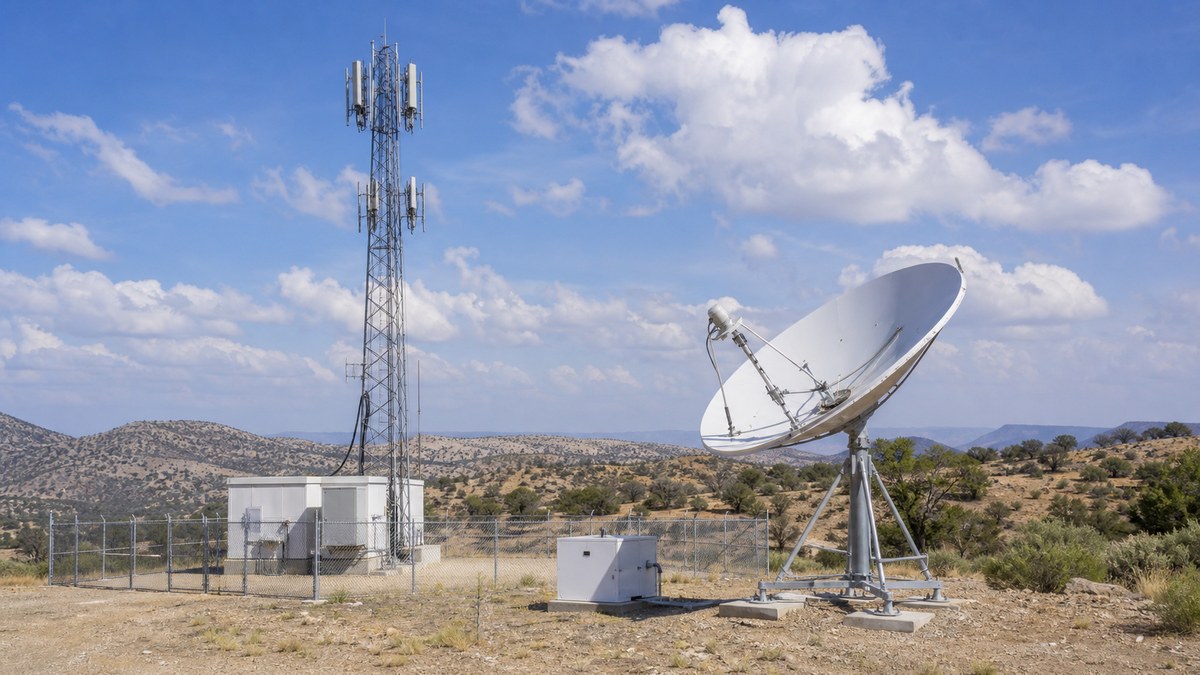
The Federal Communications Commission has given AST SpaceMobile a narrow window to test satellite-delivered cellular service over a newly available slice of 800 MHz spectrum. The experiment could help determine whether the low-band frequencies can extend ordinary carrier coverage beyond the reach of cell towers, but it is not a commercial launch and will not immediately change any wireless plan.
The FCC’s special temporary authority record covers a 30-day test rather than permanent operating rights. AST may use as many as 100 commercially available devices within two limited test areas: one around Midland, Texas, and another around Lanham, Maryland. The operating authority runs through September 12, 2026.
The approved frequencies are 817-824 MHz for transmissions from the ground to space and 862-869 MHz in the opposite direction. That spectrum was recently transferred by T-Mobile to Grain Management as part of a broader exchange in which T-Mobile received Grain’s 600 MHz licenses and $2.9 billion in cash.
Why this spectrum test matters
Low-band spectrum is valuable because its signals generally travel farther than higher-frequency signals and handle obstacles better. Those characteristics have made frequencies around 700, 800 and 850 MHz important building blocks for broad-area cellular networks, particularly outside dense urban centers.
AST is testing whether satellites can use the 800 MHz block as another coverage layer. Instead of replacing a carrier’s towers, supplemental coverage from space is meant to serve locations where the terrestrial network is unavailable. The practical targets include rural roads, remote recreation areas and communities where terrain or economics make conventional construction difficult.
The FCC has already granted AST authority to operate a planned constellation of as many as 248 satellites for supplemental coverage in the United States. That larger authorization involves spectrum arrangements with AT&T, Verizon and FirstNet. The new temporary grant addresses a different 800 MHz block and creates a controlled opportunity to evaluate it with existing commercial equipment.
That distinction matters. Regulatory permission for a small test does not prove that the service has the capacity, reliability or economics required for a nationwide product. Satellite coverage also faces constraints that tower-based advertising tends to obscure: available capacity must be shared over large areas, a clear view of the sky can matter, and performance may differ sharply from a normal 5G connection.
The carrier relationships remain unsettled
Light Reading’s independent report found that the original FCC grant, published August 13, required operations to comply with existing agreements between AST and T-Mobile. An updated grant posted August 17 removed that condition and contained no T-Mobile reference. Light Reading said it asked T-Mobile what agreements the original language described.
The revision leaves an important uncertainty: the test itself should not be read as evidence that T-Mobile has selected AST as a satellite partner. T-Mobile has an existing direct-to-device relationship with SpaceX’s Starlink, while AT&T and Verizon have publicly aligned with AST. All three national carriers have also announced plans for a joint satellite-connectivity venture intended to pool some spectrum resources and work with multiple satellite operators.
AT&T Chief Operating Officer Jeff McElfresh publicly described the test authorization as another milestone in closing connectivity gaps. Even so, Light Reading reported that it was unclear whether AT&T was participating directly in this 30-day experiment. The frequencies being tested belong to Grain, not to the 800 MHz cellular holdings that underpin AST’s existing arrangements with AT&T and Verizon.
The trial therefore has industry significance beyond its two test zones. If the spectrum works effectively for satellite links, it could become useful to several carriers or to their planned joint venture. The outcome could also influence how Grain leases or otherwise commercializes the licenses. None of those possible arrangements is established by the temporary authorization.
What wireless customers should expect
Customers do not need to change plans, enable a feature or buy equipment because of this test. The authorization permits technical evaluation, not paid consumer service, and the test areas should not be mistaken for new coverage zones.
When carriers eventually attach satellite coverage to retail plans, the details will matter more than the satellite logo: which plans qualify, whether messaging and data are both supported, what speeds apply, whether usage costs extra and which locations count as outside terrestrial coverage. A carrier claim of nationwide satellite reach may still describe an emergency or low-capacity fallback rather than a full substitute for LTE or 5G.
For now, the measurable development is modest but concrete: AST can test a strategically useful low-band spectrum block with ordinary commercial equipment through September 12. The next consumer-relevant step will be published test results or a carrier announcement that turns those results into specific coverage, pricing and eligibility terms.